Andrew and Eric reject the sacrifice
The Cabin at the End of the WorldAndrew and Eric reject the sacrifice when the demand for a loved one’s death becomes immediate between them. Under threat of an approaching apocalypse, Eric raises a gun to take his own life, while Andrew turns it toward himself; neither will kill the other. Their refusal ends the ultimatum’s power to dictate their choice, though it does not resolve whether the disasters are real or what consequences may follow. Instead, they lower the weapon, lean into each other, and make a plan to carry Wen onward.
The ultimatum and its repeated force
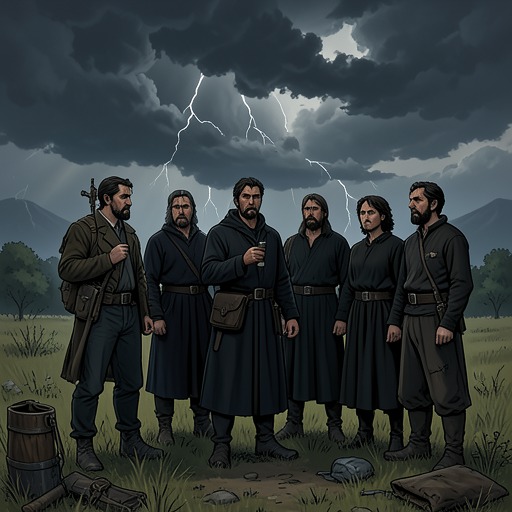
Leonard presents the family with a stark condition: one of the three must willingly be chosen and killed, or the rest of humanity will perish. The family, Leonard claims, would survive only to witness the end and remain alone in the devastated world. Andrew struggles to take in the demand and its possible consequences, imagining the ruins of Cambridge and Boston before turning away from the image. Wen is hidden behind his chair; he wants to shield her from Leonard’s words, though he knows she cannot simply avoid hearing them.
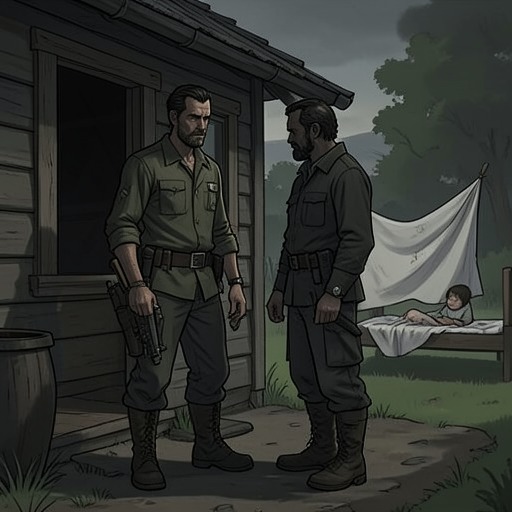
Leonard promises that the intruders will not kill Andrew, Eric, or Wen themselves, and says they will remain in the cabin until the family chooses or its time runs out. That assurance does not make the situation voluntary: the family is confined, confronted with a threat to humanity, and told that its own survival depends on carrying out a killing. Leonard later presents the choice again as a gift and as a selfless act, setting it against the alternative of letting the clock move closer to “permanent midnight.” His repeated formulation gives the demand a ritual regularity, but not an escape from its coercive terms.
The intruders leave the family to reflect, while the news shows catastrophic earthquake and tsunami coverage. Andrew says there is no need to wait until morning and that they will not change their minds. Later, as the intruders press them again, Eric tries to delay a decision by asking Adriane about the restaurants where she once worked. His attempt to draw the group into conversation cannot stop them closing ranks. The contrast is consequential: the family is urged to make a deliberate choice, yet the deadline and confinement keep narrowing the space in which any choice could be made freely.
From doubt to an intimate crisis
As the pressure continues, Andrew questions whether the intruders are really prepared to kill one another, and whether they would eventually turn on his family. He still does not understand why they are killing themselves. The uncertainty is not abstract: the choice Leonard describes requires one family member to kill another, while the disasters shown on television give the ultimatum apparent confirmation. Andrew asks Eric directly whether he thinks one of them must be killed to prevent the end of the world. Eric answers by asking why the four intruders would invent the claim and subject the family to this ordeal.
At the final confrontation, Eric acknowledges that he believes one of them must die. Andrew answers that he loves Eric and will not let him do this, while Eric returns his love and says he is sorry. Eric asks whether the figure in the light is present. It is not. He feels its absence and hopes, nevertheless, that it might appear and guide him as it seemed to guide the others. With no such presence to direct him, the immediate decision remains between the two men.
Andrew drops his gun on the wet road and approaches Eric without his walking stick, stopping within reach. Eric asks him not to take the gun and points it beneath his own chin. Andrew promises not to touch it, then gently takes it away from Eric’s chin and turns its muzzle toward his own chest. He frames shooting him as a sacrifice that would leave Eric alone. Eric considers whether he could shoot Andrew and then himself, but Andrew does not answer. The exchange makes the apparent choice painfully personal: even an attempt to satisfy the demand would leave the survivor confronting the loss of the person he most wishes to protect.
Refusal and what follows
Eric asks what would happen if the apocalypse were real. Andrew’s answer does not depend on disproving it: even if it is real, they will not hurt each other. When Eric says they cannot go on, Andrew insists that they will. Eric pulls the gun away from Andrew’s chest, lowers his arm, and drops the weapon to the forest floor. He leans into Andrew, who leans back; their hands find each other and hold on. The change is both practical and relational: the gun ceases to be an instrument of the required sacrifice, and physical closeness replaces the stance of a person preparing to die.
The refusal does not bring certainty or safety. The storm continues overhead, and the dark sky and lightning remain open to more than one interpretation: they may seem hostile, but the men have endured other storms, and neither can know whether this one is different. The narration likewise does not establish whether the prophecy has been defeated. It shifts into a first-person plural account of what the men intend to do, placing their shared future against the ultimatum’s demand that one choose death.
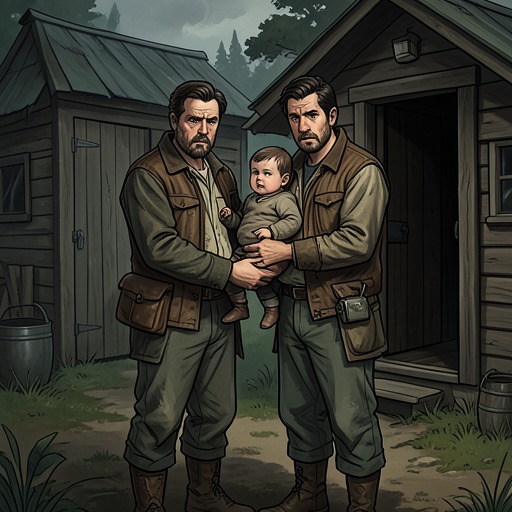
Their plan is concrete despite that uncertainty. They will retrieve the truck keys from the mud, lift Wen into their arms, and carry her. They intend to remember and love her, then walk down the road whether it is flooded, blocked by fallen trees, or split by fissures, and continue along the dangerous roads beyond it. The ending thus makes no claim that the family has escaped the catastrophe. Its decisive outcome is narrower and more immediate: Andrew and Eric refuse to become each other’s executioner, put down the gun, and choose to face whatever comes together.